
Breed guide
Scottish Terrier
The Scottish Terrier, often called the "Scottie," is best recognized for its distinctive profile and hard, wiry, weather-resistant outer coat in a black, brindle, or wheaten color. Its beard, eyebrows, legs, and lower body furnishings are traditionally shaggy. Like many breeds in the Terrier Group, Scotties are small yet strong and known as fast, alert and playful dogs. The Scottish Terrier is the only breed of dog that has lived in the White House three times, with Presidents Roosevelt, Eisenhower, and George W. Bush.
- Full breed profile
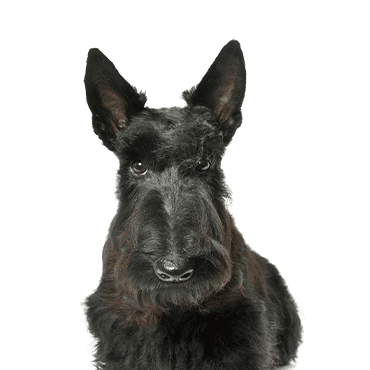
About the Scottish Terrier
The Scottish Terrier, often called the “Scottie,” is best recognized for its distinctive profile and hard, wiry, weather-resistant outer coat in a black, brindle, or wheaten color. Its beard, eyebrows, legs, and lower body furnishings are traditionally shaggy. Like many breeds in the Terrier Group, Scotties are small yet strong and known as fast, alert and playful dogs. The Scottish Terrier is the only breed of dog that has lived in the White House three times, with Presidents Roosevelt, Eisenhower, and George W. Bush.
History
Naturally a “digger” at heart, the Scottie was originally bred to hunt and kill vermin on farms. King James VI, known to adore the breed, is said to be responsible for the rise in popularity in Scotland during his reign. Scotties were introduced to America in the 1890s and continue to remain a common fixture in American households.
Temperament
Scotties thrive as house pets and are gentle, loving members of their families. Their spirited natures require obedience training, and they need regular exercise (on a leash, as the chase instinct is strong). The Scottie coat requires regular brushing and clipping to maintain the characteristic breed outline.
- Terrier Group; AKC recognized in 1885.
- Ideal height is 10 inches tall at the shoulder and weighing from 18 to 22 pounds.
- Fox/vermin hunter.
Environment
- Apartment is fine.
- Active indoors.
Exercise
- Daily moderate exercise.
Grooming
- Regular brushing.
- Periodic professional grooming recommended.
- Little to no shedding.
What they are like
to live with
The things worth knowing before you bring a Scottish Terrier home.
-
History
Naturally a “digger” at heart, the Scottie was originally bred to hunt and kill vermin on farms. King James VI, known to adore the breed, is said to be responsible for the rise in popularity in Scotland during his reign. Scotties were introduced to America in the 1890s and continue to remain a common fixture in American households.
-
Temperament
Scotties thrive as house pets and are gentle, loving members of their families. Their spirited natures require obedience training, and they need regular exercise (on a leash, as the chase instinct is strong). The Scottie coat requires regular brushing and clipping to maintain the characteristic breed outline.
- Terrier Group; AKC recognized in 1885.
- Ideal height is 10 inches tall at the shoulder and weighing from 18 to 22 pounds.
- Fox/vermin hunter.
-
Environment
- Apartment is fine.
- Active indoors.
-
Exercise
- Daily moderate exercise.
-
Grooming
- Regular brushing.
- Periodic professional grooming recommended.
- Little to no shedding.
Interested in a Scottish Terrier?
Tell us what you are looking for and we will get back to you as soon as we can. Or call the store and speak to somebody today.
Come and meet a Scottish Terrier
in person
Walk in any day we are open. Our Puppy Ambassadors will introduce you, answer every question and help you find the one who picks you.
-
Puppygram Indianapolis
9546 Allisonville Rd
Indianapolis, IN 46250- Mon – Sat
- 12 PM – 8 PM
- Sun
- 12 PM – 6 PM
-
Puppygram Louisville
2056 S Hurstbourne Pkwy
Louisville, KY 40220- Mon – Sat
- 12 PM – 8 PM
- Sun
- 12 PM – 6 PM
-
Puppygram Metro Detroit
28297 Suite B Woodward Ave
Berkley, MI 48072- Mon – Sat
- 12 PM – 8 PM
- Sun
- 12 PM – 6 PM